A speedier travel solution opens in northern Wake County – let’s visit and learn together
US 401 north is a major connector for Wake and Franklin counties, connecting downtown Raleigh with the southeast Wake Forest area, Rolesville and Louisburg. (US 401 is also Capital Boulevard between downtown Raleigh and the Mini City area of Raleigh).
Over the past few years, NCDOT has worked to improve the US 401 north corridor, widening the roadway, adding multimodal elements, and improving traffic flow at major intersections in northern Wake County.
One of these high-volume intersection locations is Perry Creek Road, where a new “reduced conflict intersection” (a/k/a superstreet or synchronized street) reduces the number of signal phases and thus decreases overall delay. There are several other synchronized street intersections and corridors around the Triangle with this design, including further north on 401 at Rolesville, as well as on NC 55 / GB Alford Highway in Holly Springs. Here is a prior public meeting map for the Perry Creek intersection improvement.
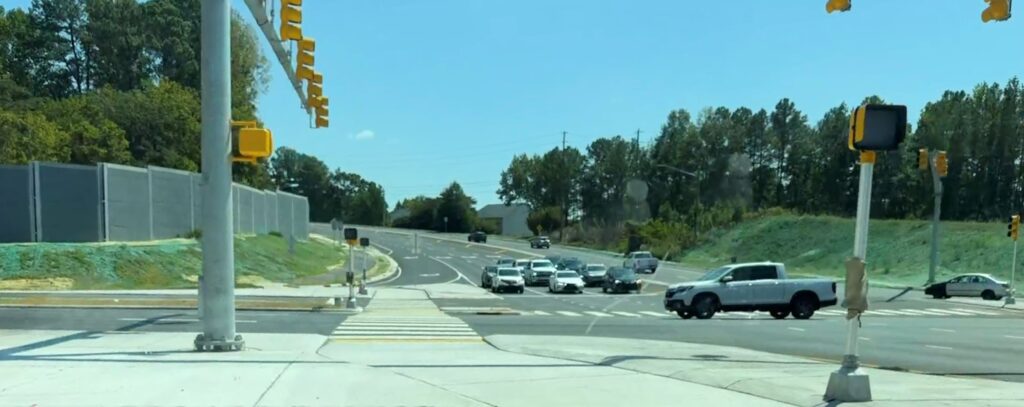
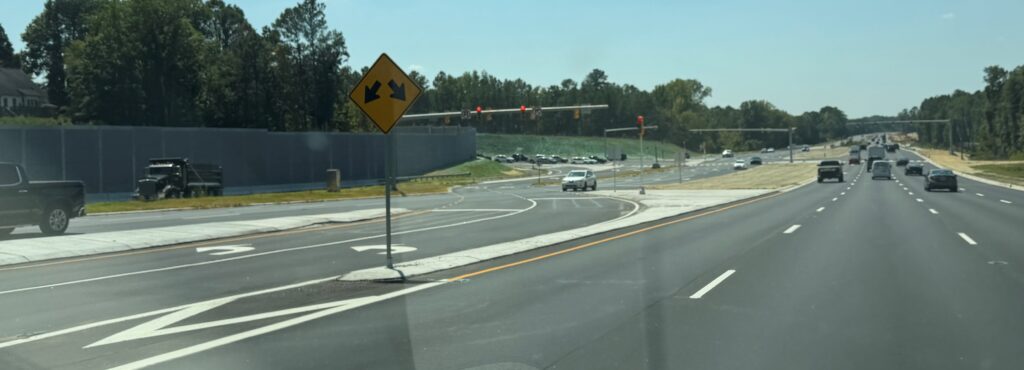
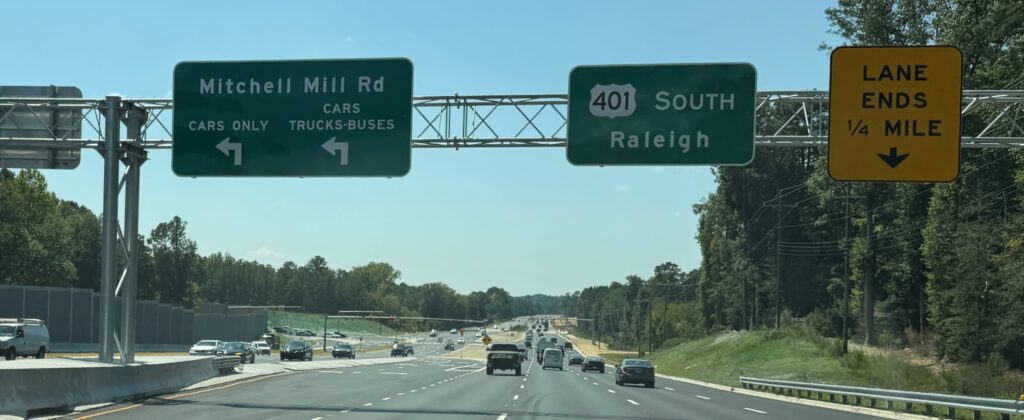
About a mile north of Perry Creek is the US 401 / Mitchell Mill Road intersection, which itself is slightly south of the US 401 / Ligon Mill Road intersection. The Mitchell Mill intersection has been completely redesigned and simplified to a “continuous flow intersection” (CFI) configuration. While “continuous flow” is somewhat of misnomer — no movements are flowing continuously at a CFI — traffic certainly flows and operates much better than before.
The CFI design deals with left turns differently than most other at-grade (no bridge involved) intersections. US 401 southbound traffic intending to turn left onto Mitchell Mill can still do so, but only via an advance left turn lane bay that stops well before the main intersection at a “holding” signal before crossing over southbound traffic. The result is that main intersection signal and the advance signal are paired, and they together operate with only two signal phases, which dramatically improves throughput and minimizes delay.
This is the first CFI for NCDOT in the eastern half of North Carolina; this improvement is already dramatically improving travel along 401 during peak periods. Many CFI projects in the United States can experience a 50% capacity increase compared to a conventional intersection. Here is a prior public meeting map for this intersection improvement.
RTA will be holding our first field visit of fall 2026 to see these improvements in northern Wake County along the US 401 north corridor, on Monday afternoon, October 12, in concert with our friends at NCDOT Division 5. Sign up via this link if you wish to participate in this visit — space is limited so you must pre-register.
Kudos to NCDOT for this excellent improvement along a major multi-county commuting and commerce corridor. These are the investments that help future proof our mobility future, and it opened around a year early, which provides needed relief sooner. Given that traffic volumes on US 401 exceed 60,000 vehicles per day, growing to 90,000+ by 2040, this is a project that truly arrived “just in time”.
See below for a few photos of the US 401 / Mitchell Mill CFI. See here for an NCDOT video.
Joe
Joe Milazzo II, PE
RTA executive director